flowchart TB
En cinco estudios analizados por J-PAL, la exposición a modelos femeninos aumentó la probabilidad de que niñas y mujeres se inscribieran en programas STEM. En Francia, una charla en clase de una hora por mujeres científicas, que proporcionaron información sobre carreras relacionadas con la ciencia, abordaron estereotipos de género y compartieron las propias experiencias de los modelos a seguir, aumentaron la probabilidad de que las niñas en el grado 12 se inscribieran en programas STEM dominados por hombres en 3,4 puntos porcentuales, desde el 17 por ciento en el grupo de comparación (un aumento del 20 por ciento).
Resumen automático
[1] "The Abdul Latif Jameel Poverty Action Lab (J-PAL) is a global research center working to reduce poverty by ensuring that policy is informed by scientific evidence. Anchored by a network of more than 900 researchers at universities around the world, J-PAL conducts randomized impact evaluations to answer critical questions in the fight against poverty."
[2] "The Abdul Latif Jameel Poverty Action Lab (J-PAL) is a global research center working to reduce poverty by ensuring that policy is informed by scientific evidence. Anchored by a network of more than 900 researchers at universities around the world, J-PAL conducts randomized impact evaluations to answer critical questions in the fight against poverty."
[3] "Across countries, women’s representation in science, technology, engineering, and mathematics (STEM) remains low. Globally, as of 2022, the percentage of women graduating with a degree in engineering and manufacturing was 7 percent, compared to 25 percent for men.1 In the United States, for example, women represented 35 percent of the STEM workforce in 2021, compared to 51 percent of the total workforce.2 Since salaries in STEM fields tend to be quite high, underrepresentation can contribute to sustained gender gaps in the labor market, affecting women’s opportunities and economic growth. Addressing such gender gaps is particularly relevant in high-income countries as the rising demand for STEM jobs is paired with shortages of STEM-skilled workers. For example, in the United States, employment in STEM fields is projected to increase 11 percent by 2032, compared to 2 percent in non-STEM occupations.3 "
[4] "While multiple factors may explain women’s underrepresentation in STEM, gender norms seem to be a relevant factor in high-income countries, shaping women’s preferences and aspirations, often very early on. [1] For example, women may perceive STEM careers to be less attractive due to internalized gender stereotypes such as women being less likely to succeed in them, lack of women role models, or overrepresentation of men in these fields. One theory is that increased exposure to women role models—including through academic programs like the Undergraduate Women in Economics (UWE)—may help to address underrepresentation driven by restrictive gender norms and improve girls’ and women’s economic opportunities, particularly in high-income countries. "
[5] "A review of seven randomized evaluations of role model interventions from four high-income countries found that exposure to women role models can positively impact women students’ participation and educational performance in STEM fields. In this context, role models are women working in science-related fields, such as teachers, practitioners, and advisors. The evidence also suggests that exposure to women role models reduced gender gaps by improving girls’ and women’s perceptions and aspirations of having STEM careers. The interventions included in this policy insight vary in the modality and duration of exposure and age of the target population. While role models’ behavior and level of professional success are important for ensuring that role models are effective, additional research can help to shed light on which role model attributes are most influential in improving gender gaps in STEM fields and in which contexts. "
[6] "Exposure to women role models generally increases the likelihood of women students entering STEM fields, especially for fields with a more severe gender imbalance."
Parsing text into sentences and tokens...DONE
Calculating pairwise sentence similarities...DONE
Applying LexRank...DONE
Formatting Output...DONE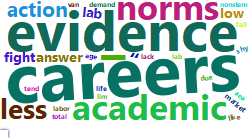
[1] "Across five studies, exposure to women role models increased the probability of girls and women enrolling in STEM programs.[1] [2] [4] [6] [7] In France, a one-hour in-class talk by women scientists— who provided information about science-related careers, addressed gender stereotypes, and shared the role models’ own experiences—increased the likelihood of girls in grade 12 enrolling in male-dominated STEM programs by 3.4 percentage points, from 17 percent in the comparison group (a 20 percent increase).[1] In Norway, researchers found in an outside-the-classroom intervention that girls whose medical doctor (MD) during childhood was a woman were 4 percentage points (20 percent) more likely to choose a science, technology, engineering, mathematics, and medicine (STEMM) program in high school."
[2] "Two studies conducted in academic settings in the United States found that exposure to role models increased the likelihood of high-performing women students choosing programs in which women were underrepresented by 8 and 26 percentage points.[2] [4] In these studies, researchers evaluated the impact of the mentor’s gender on students’ occupational choice at a military academy and the impact of the professor’s gender during introductory courses at the undergraduate level, respectively. "
[3] "The evidence also suggests that exposure to women role models reduced gender gaps by improving girls’ and women’s perceptions and aspirations of having STEM careers."
Resumen
En cinco estudios, la exposición a modelos femeninos aumentó la probabilidad de que niñas y mujeres se inscribieran en programas STEM. En Francia, una charla en clase de una hora por mujeres científicas, que proporcionaron información sobre carreras relacionadas con la ciencia, abordaron estereotipos de género y compartieron las propias experiencias de los modelos a seguir, aumentaron la probabilidad de que las niñas en el grado 12 se inscribieran en programas STEM dominados por hombres en 3,4 puntos porcentuales, desde el 17 por ciento en el grupo de comparación (un aumento del 20 por ciento).
En Noruega, los investigadores encontraron en una intervención fuera del aula que las niñas cuyo médico (MD) durante la infancia era una mujer tenían 4 puntos porcentuales (20 por ciento) más probabilidades de elegir un programa de ciencia, tecnología, ingeniería, matemáticas y medicina (STEMM) en la escuela secundaria.
Dos estudios realizados en entornos académicos en los Estados Unidos encontraron que la exposición a modelos a seguir aumentaba la probabilidad de que estudiantes de alto rendimiento eligieran programas en los que las mujeres estaban subrepresentadas entre 8 y 26 puntos porcentuales. En estos estudios, la investigación evaluó el impacto del género del mentor en la elección ocupacional de los estudiantes en una academia militar y el impacto del género del profesor durante los cursos introductorios a nivel de pregrado, respectivamente.
La evidencia también sugiere que la exposición a modelos femeninos redujo las brechas de género al mejorar las percepciones y aspiraciones de las niñas y las mujeres de tener carreras STEM.
Reutilización
Cómo citar
BibTeX
@online{robano2024,
  author = {Robano, Virginia},
  title = {Evidencia de J-PAL en equidad de género},
  date = {2024-03-17},
  url = {https://ceibal-fichas-genero-stem.netlify.app/posts/J-PAL evidencia en género/},
  langid = {es}
}
Por favor, cita este trabajo como:
Robano, Virginia. 2024. “Evidencia de J-PAL en equidad de
género.” March 17, 2024. https://ceibal-fichas-genero-stem.netlify.app/posts/J-PAL
evidencia en género/.